To illustrate the essence of ‘change of coordinates’, consider two ordered bases \(\EuScript{A} = (\Vect{a}_1,\Vect{a}_2)\) and \(\EuScript{B}=(\Vect{b}_1,\Vect{b}_2)\) in \(\RNr[2]\). Now, given a vector \(\Vect{x}\) in \(\RNr[2]\), we may
-
express \(\Vect{x}\) in a unique way as a linear combination of \(\EuScript{A}:\)
\[\Vect{x} = u \Vect{a}_1 + v \Vect{a}_2,\quad \text{and so}\quad \Vect{x}_{\EuScript{A}} = (u,v)\]The \(\EuScript{A}\)-coordinates of \(\Vect{x}\) are \((u,v)\)
-
express \(\Vect{x}\) in a unique way as a linear combination of \(\EuScript{B}:\)
\[\Vect{x} = s \Vect{b}_1 + t \Vect{a}_2,\quad \text{and so}\quad \Vect{x}_{\EuScript{B}} = (s,t)\]The \(\EuScript{B}\)-coordinates of \(\Vect{x}\) are \((s,t)\)
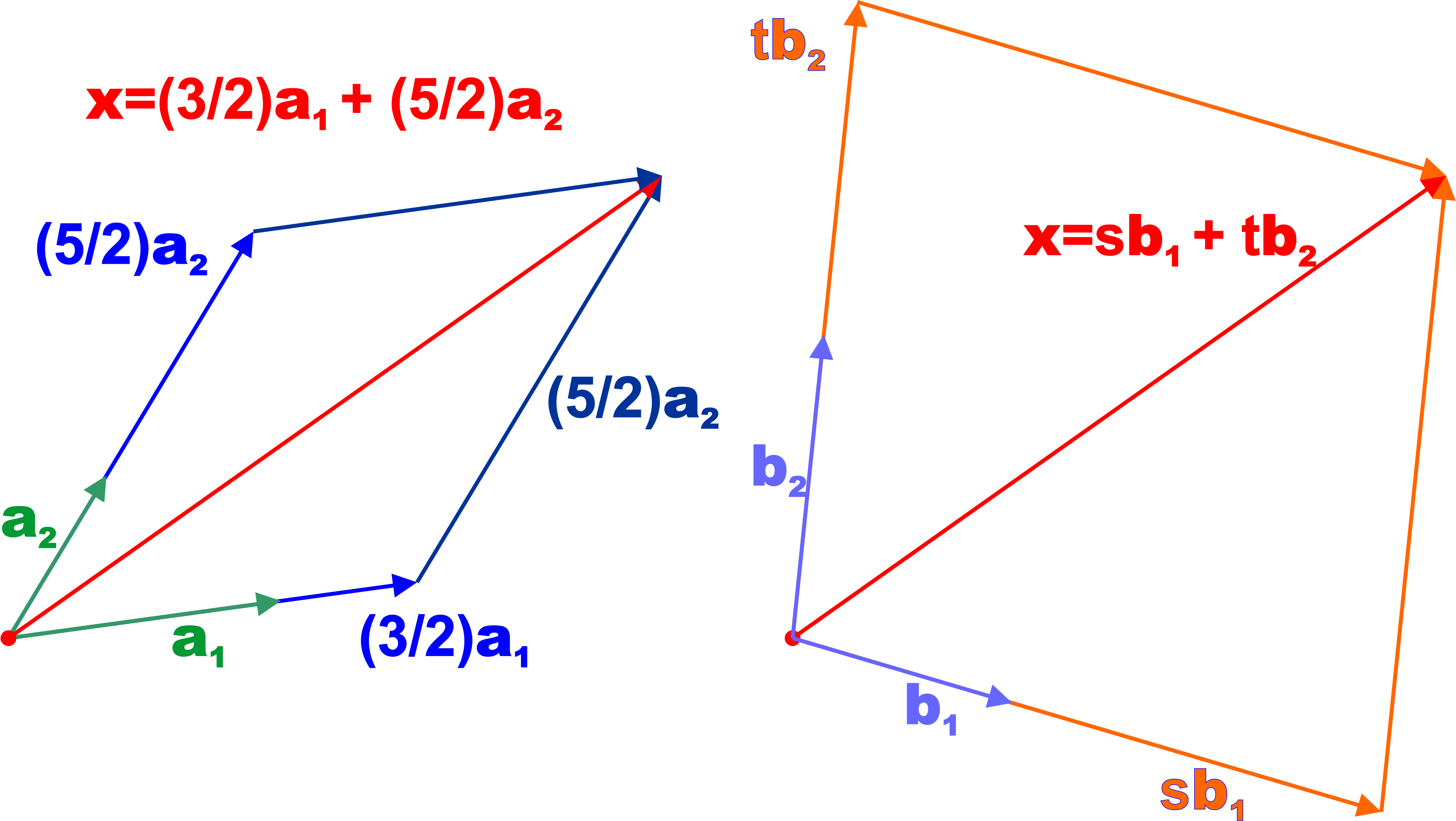
Here \(\Vect{x}_{\EuScript{A}} = \left( \tfrac{3}{2} , \tfrac{5}{2} \right)\)
So we arrive at the question: suppose we know the \(\EuScript{A}\)-coordinates of \(\Vect{x}\), what are its \(\EuScript{B}\)-coordinates? and, vice versa, suppose we know the \(\EuScript{B}\)-coordinates of \(\Vect{x}\), what are its \(\EuScript{A}\)-coordinates?