The orthogonal complement of a collection of vectors \(S\) in \(\RNrSpc{n}\) consists of all those vectors in \(\RNrSpc{n}\) which are perpendicular to every vector in \(S\).
For example, the orthogonal complement of a single nonzero vector \(\Vect{n}\) in \(\RNrSpc{n}\) consists of all those vectors \(\Vect{x}\) for which \(\DotPr{ \Vect{x} }{ \Vect{n} } = 0\). This, we recognize, is the hyperspace of vectors perpendicular to \(\Vect{n}\).
For example, the orthogonal complement of two vectors \(\Vect{u}\) and \(\Vect{v}\) consists of all those vectors \(\Vect{x}\) which are perpendicular to both \(\Vect{u}\) and \(\Vect{v}\); etc. –
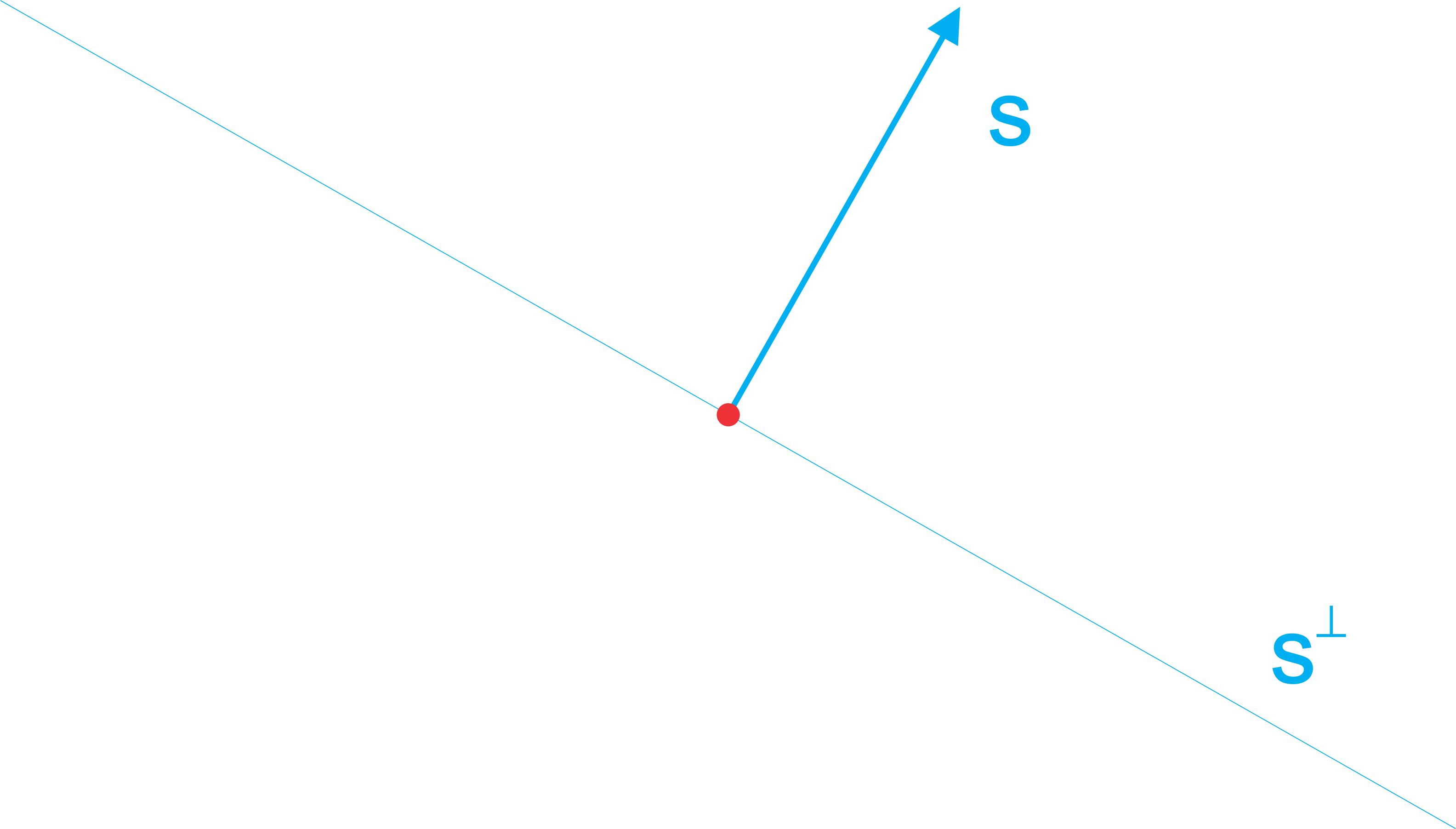
The picture below shows a vector \(\Vect{s}\) in \(\RNrSpc{2}\), together with its orthogonal complement \(\Vect{s}^{\bot}\), the line perpendicular to \(\Vect{s}\). (The red dot represents the origin.)
The orthogonal complement of \(\Vect{s}\) in \(\RNrSpc{2}\)
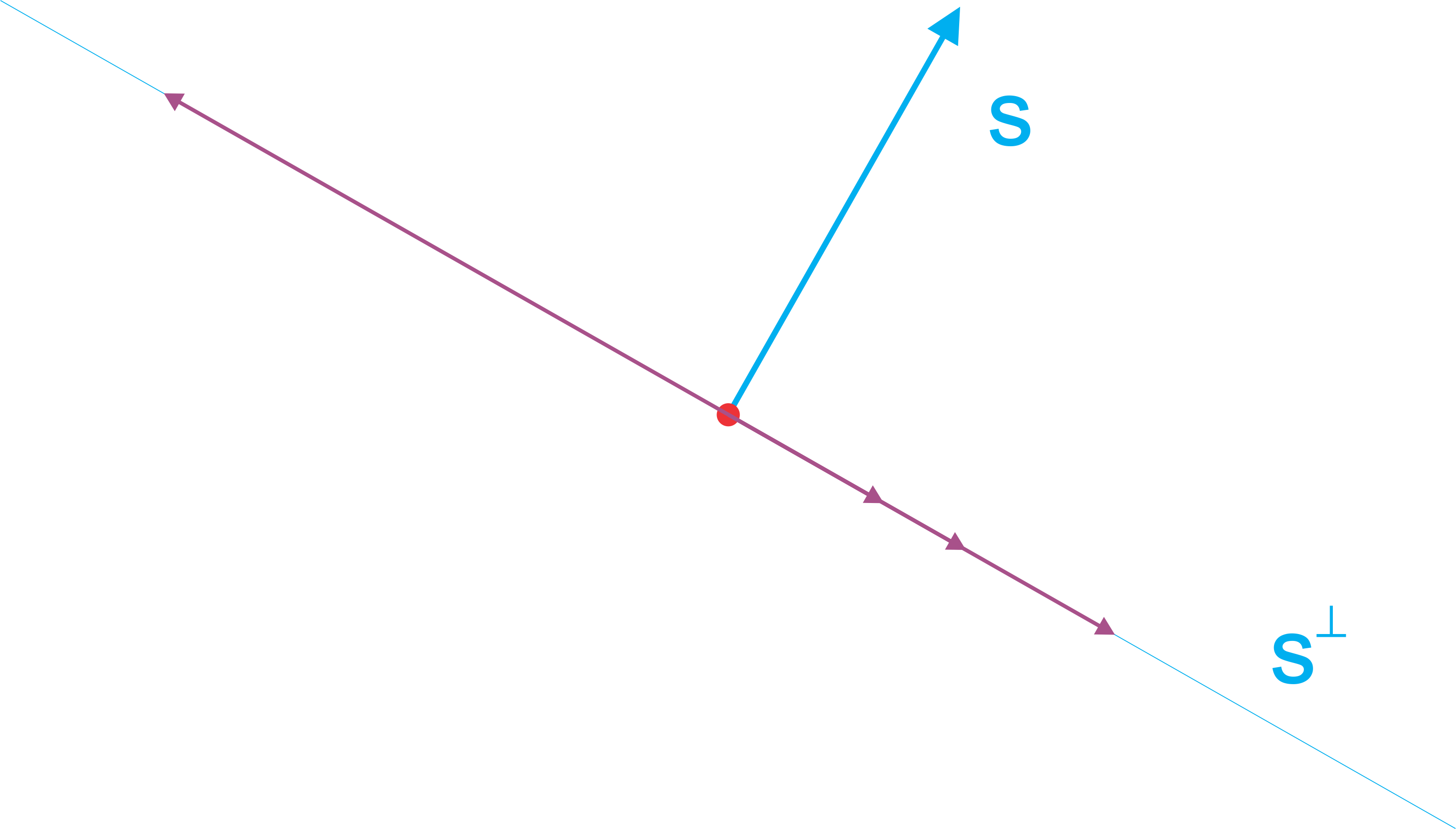
Note that \(\Vect{s}^{\bot}\) consists of an infinite collection of vectors, namely all those vectors which are perpendicular to \(\Vect{s}\)
The orthogonal complement of \(\Vect{s}\) in \(\RNrSpc{2}\)
The orthogonal complement of a single nonzero vector is always a hyperspace.
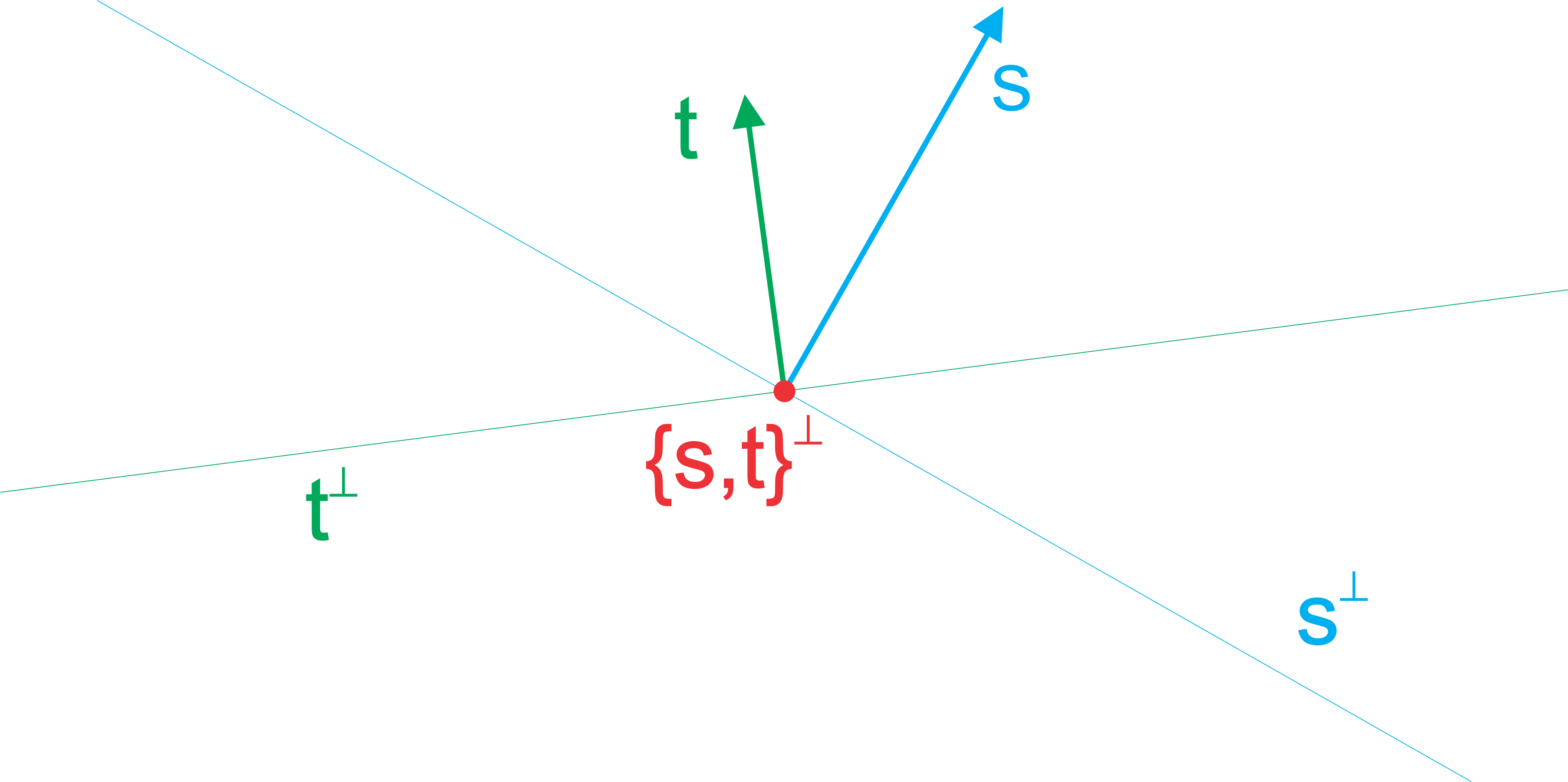
The picture below shows two vectors \(\Vect{s}\) and \(\Vect{t}\) in \(\RNrSpc{2}\), together with their respective orthogonal complements:
the line perpendicular to \(\Vect{s}\), and
the line perpendicular to \(\Vect{t}\)
The orthogonal complement of the set \(S\DefEq \Set{ \Vect{s},\Vect{t} }\) consists of all vectors in the plane which are perpendicular to both \(\Vect{s}\) and \(\Vect{t}\). Thus the orthogonal complement of \(S\) is the intersection of the hyperspace perpendicular to \(\Vect{s}\) and the hyperspace perpendicular to \(\Vect{t}\). In this case \(S^{\bot}\) is just the origin, represented here by a red dot.