The collection of vectors in a subvector space \(V\) of \(\RNrSpc{n}\) is closed under vector addition. Here are some illustrations of what this means.
The subset below is closed under vector addition and scalar multiplication. So it is a subspace of \(\RNrSpc{n}\).
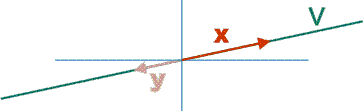
In contrast, here is a subset \(V\) of \(\RNrSpc{2}\) which fails to be closed under vector addition. It is, therefore, not a subvector space.
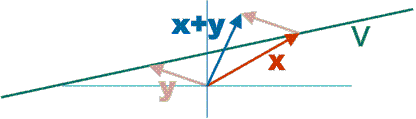
Indeed, there are (at least) two vectors \(\Vect{x}\) and \(\Vect{y}\) in \(\RNrSpc{3}\) whose sum \(\Vect{x} + \Vect{y}\) is not in \(V\). This means that this line is not closed under vector addition, hence is not a subvector space.
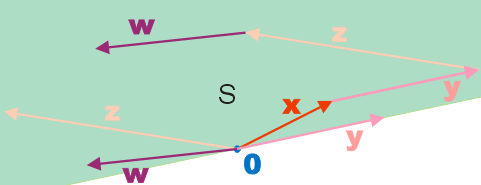
The green half plane below is closed under vector addition, but not under scalar multiplication. For example, the vector \(-\Vect{x}\) is not in \(S\). Therefore \(S\) is not a subvector space.