Distance of a Point from a Hyperplane – Illustration
In \(\RNrSpc{2}\) and in \(\RNrSpc{3}\) we illustrate what we mean by ‘distance of a point from a hyperplalne’.
In \(\RNrSpc{2}\) a hyperplane is a line. So we will develop a formula which computes the distance of a point \(Q\) in \(\RNrSpc{2}\) from a line \(L\) in \(\RNrSpc{2}\).
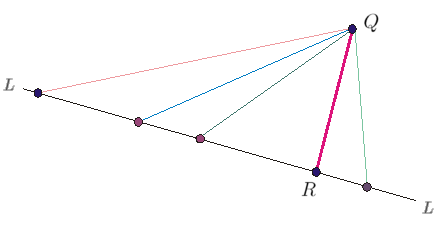
Given a line \(L\) in \(\RNrSpc{2}\) and a point \(Q\), there is always exactly one point \(R\) on \(L\) which is closest to \(Q\). So we define the distance from \(Q\) to the line \(L\) to be the distance from \(Q\) to \(R\).
In \(\RNrSpc{3}\) a hyperplane is a plane in the conversational sense. So we will develop a formula which computes the distance of a point \(Q\) in \(\RNrSpc{3}\) from a plane \(H\) in \(\RNrSpc{3}\).
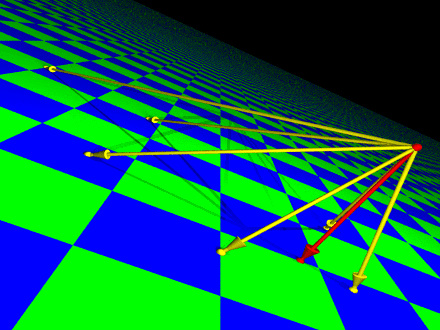
Given a plane \(H\) in \(\RNrSpc{3}\) and a point \(Q\), there is always exactly one point \(R\) on \(H\) whose distance from \(Q\) is less than the distance of any other point on \(H\) from \(Q\). Thus we define the distance from \(Q\) to \(H\) to be the distance from \(Q\) to the point on \(H\) closest to \(Q\).
Distance of a Point from a Hyperplane – Illustration